The Architects of Arda: Inside the Fan Communities Constructing Middle-earth's Forgotten Millennia
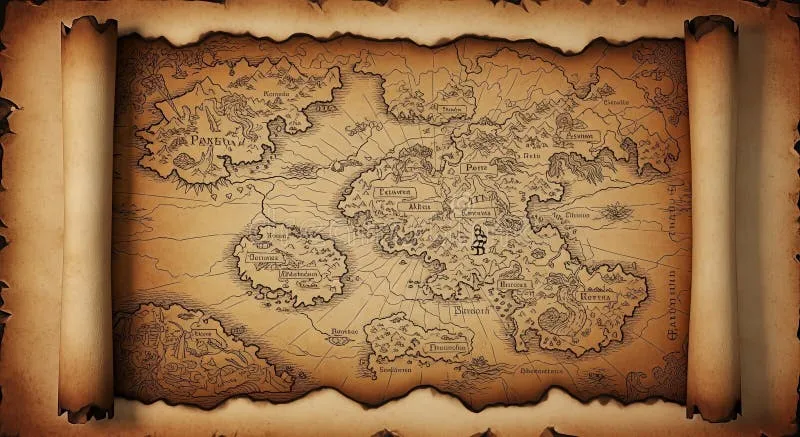
Photo: ancient map parchment fantasy world cartography handwritten scroll, via thumbs.dreamstime.com
The Silmarillion ends. The appendices of The Return of the King trail into genealogical tables. Unfinished Tales breaks off mid-sentence in places, as though Tolkien himself walked away from the desk and never returned. For the casual reader, these gaps are simply the edges of a story. For a particular kind of devoted fan, they are an invitation — perhaps the most serious invitation in all of speculative fiction.
Across dedicated wikis, Discord servers, and long-running collaborative fiction archives, a thriving community of fan world-builders is doing something that goes well beyond ordinary fan creativity. They are constructing entire histories: inventing the internal politics of the First Age kingdoms that Tolkien named but never fully dramatized, building genealogical records for noble houses mentioned only in passing, and writing the cultural histories of peoples — Easterlings, Haradrim, the Men of the twilight ages — who appear in the published works largely as background figures. The scope of this work is, in the most literal sense, civilizational.
Two Schools of World-Building
Within the fan world-building community, two broad approaches have emerged, each with its own aesthetic philosophy and its own relationship to Tolkien's source material.
The first might be called the extrapolative school. Practitioners of this method treat Tolkien's texts — including the posthumously published volumes edited by Christopher Tolkien — as primary documents to be studied with something approaching academic rigor. They cross-reference dates from the appendices against events described in The Silmarillion, identify contradictions in Tolkien's various drafts, and attempt to construct internally consistent timelines that honor the author's evolving intentions. Many of these world-builders are also students of Old English, Norse mythology, and medieval history, disciplines that inform their understanding of the cultural logic underlying Tolkien's own inventions.
The work produced by this school tends toward the scholarly. Elaborate spreadsheets track the lifespans of Númenórean noble lines. Annotated maps note where Tolkien's own cartography is ambiguous. Some projects have produced documents running to hundreds of pages — effectively companion volumes to the published canon, written entirely by fans.
The second approach is more expansive, and considerably more willing to depart from established lore. Where the extrapolative school asks what Tolkien might have intended, the reimaginative school asks what Middle-earth could become. These world-builders treat Tolkien's creation as a foundation rather than a boundary, constructing cultures and histories that may contradict or substantially revise what little the canonical texts establish. They are more likely to center peoples and perspectives that the original works marginalized, to imagine the internal lives of cultures that appear in the published work only as antagonists or background detail, and to bring contemporary concerns about representation and historical complexity into conversation with Tolkien's mythological framework.
The Haradrim Problem — and Its Solutions
Few subjects illustrate the difference between these two schools more clearly than the treatment of Tolkien's southern and eastern peoples. In the canonical texts, the Haradrim, the Easterlings, and their kin are largely defined by their allegiance to Sauron and their opposition to the forces of the West. Tolkien himself acknowledged in his letters that this framing reflected limitations he wished he had addressed more fully.
Fan world-builders have responded to this gap with remarkable creative energy. Extrapolative projects have attempted to reconstruct what pre-Sauron Haradric civilization might have looked like, drawing on the author's own notes about climate and geography south of Gondor to hypothesize trade economies, religious traditions, and political structures. Reimaginative projects have gone further still, producing elaborate fictional histories in which the peoples of Harad have rich interior lives entirely independent of their relationship to the conflict at the center of The Lord of the Rings.
Some of the most ambitious work in this vein has come from American fan communities, where questions of whose perspective a story centers — and who gets to be a full human being within a narrative — carry particular cultural weight. These world-builders are not simply filling gaps; they are asking what kind of world Arda might have been if its author had lived to revise it with a wider lens.
Canon as Conversation
One of the most philosophically interesting aspects of fan world-building is what it implies about the nature of canon itself. For many participants in these communities, Tolkien's published works are not a closed system to be preserved but a generative text to be extended — much as medieval authors routinely expanded, revised, and reinterpreted the mythological material they inherited. Tolkien himself, of course, did exactly this with the Norse and Old English sources that shaped his imagination.
This perspective has significant implications for how the Galadhrim community discusses authenticity and fidelity. If Tolkien's own method was one of continuous revision, elaboration, and reimagining — as the volumes of The History of Middle-earth make unmistakably clear — then fan world-builders who work in the same spirit may have a stronger claim to the tradition than is often acknowledged. The question is not whether fan-constructed histories are canonical in any formal sense, but whether they participate meaningfully in the same creative conversation that produced the canonical texts in the first place.
Why This Work Matters
For the people who do it, fan world-building is rarely described as a hobby in the casual sense. It is, by most accounts, a form of sustained intellectual and creative engagement that deepens over years and sometimes decades. Participants describe learning languages, studying history, and developing research skills they carry into their professional lives — all in service of understanding a fictional world more completely.
What emerges from the best of this work is something genuinely valuable: a Middle-earth that feels not smaller for the scrutiny but larger, more detailed, more fully alive. The gaps that Tolkien left are not failures of imagination but the natural edges of a creation built by one person across one lifetime. The fan world-builders who have taken up residence in those gaps are, in a very real sense, doing what Tolkien always hoped his mythology would invite: they are making it their own, and in doing so, they are keeping it alive.