Drowned in Ambition: How Númenor Became Fantasy's Most Haunting Cautionary Tale
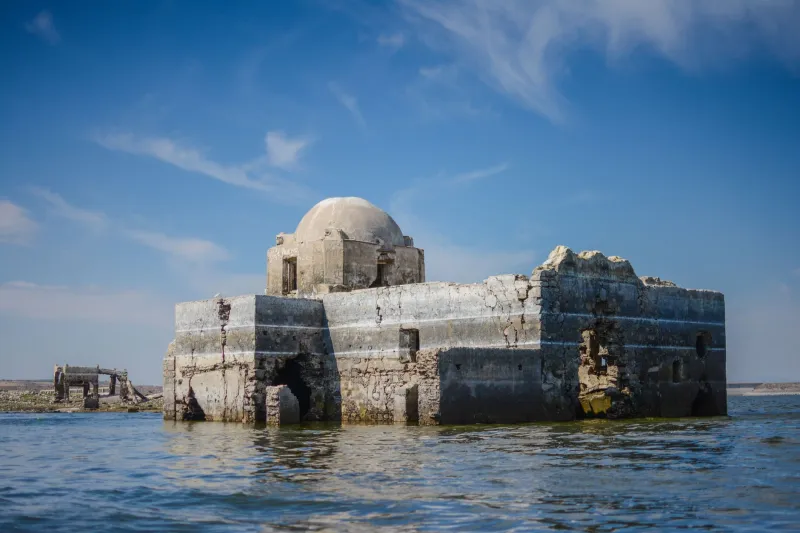
There is a particular cruelty in Tolkien's treatment of Númenor. He gave readers the outline of a civilization so magnificent it staggers the imagination — a seafaring empire of men elevated by the Valar themselves, gifted with long life, architectural genius, and dominion over the waves — and then he sank it. Literally. The island kingdom does not decline gradually or fade into irrelevance. It is swallowed whole by the sea, erased from the map of Arda, and reduced in the surviving texts to fragments: genealogies, laments, disputed chronicles, and the haunted memories of those few who escaped aboard nine ships to found what would eventually become Gondor and Arnor.
That deliberate fragmentation is not an accident of Tolkien's legendarium. It is its central artistic gesture. And for fans of Middle-earth, it has become an invitation that has proven almost impossible to refuse.
The Architecture of a Ruin
The primary account of Númenor's history, Akallabêth, occupies a relatively slender portion of The Silmarillion, yet it carries the weight of an entire civilization's arc. Tolkien traces the island's founding after the First Age, its centuries of glory, and the gradual corruption of its ruling class through fear of death and resentment of the Valar's prohibition against sailing west toward the Undying Lands. The final king, Ar-Pharazôn, seduced by Sauron — who had surrendered himself as a prisoner and then systematically dismantled the kingdom's moral foundations from within — launches an armada against Valinor itself. The Valar lay down their guardianship, Ilúvatar intervenes directly, and Númenor disappears beneath the ocean.
What Akallabêth does not provide is equally significant: the texture of daily life, the internal debates among the Faithful who resisted Sauron's influence, the architectural record of cities that no longer exist, the full scope of Númenórean naval exploration along the coasts of Middle-earth. Tolkien gestures toward these realities without rendering them. The result is a ruin that feels real precisely because so much of it has been lost.
This is, of course, intentional. Tolkien was a philologist who understood that historical authenticity is often communicated through gaps. Genuine ancient records are fragmentary. Languages carry the ghosts of civilizations that left no other trace. By constructing Númenor as a recovered mythology rather than a fully realized narrative, he embedded within the legendarium an epistemological honesty that most world-builders never attempt.
The Fandom's Reconstruction Project
The community that has grown around Middle-earth has never been content to let those gaps remain empty. Fan scholars have spent decades cross-referencing Unfinished Tales, the twelve volumes of The History of Middle-earth, and every marginal note Christopher Tolkien preserved from his father's manuscripts in an effort to reconstruct what Númenor might have looked like in its fullness. Timelines have been debated with the rigor of academic historians. The city of Armenelos, the royal capital, has been mapped and remapped by fan cartographers working from the barest descriptive details. The culture of the Faithful — those Númenóreans who maintained their reverence for the Valar and ultimately survived the Downfall under Elendil's leadership — has been elaborated into something approaching a complete social portrait.
What drives this reconstruction is not mere completionism. There is something in Númenor's story that resonates with readers in ways that feel almost contemporary. An empire that begins with genuine virtue, that earns its prosperity through courage and wisdom, and that then turns those same qualities toward domination and self-aggrandizement — this is not an obscure mythological pattern. It is among the most recognizable narratives in recorded human history. American readers, in particular, may find themselves sitting with a particular discomfort when tracing Númenor's arc: the progression from exceptional founding ideals to imperial overreach is not an unfamiliar story on this side of the Atlantic.
Tolkien was drawing on classical sources — the myth of Atlantis most obviously, but also the trajectories of Rome and the cautionary literature embedded in the Old Testament — yet the result feels disturbingly modern. Fans are not simply reconstructing a fantasy civilization. They are working through the question of how great things fail, and why the very qualities that produce greatness so often carry within them the seeds of destruction.
What Recent Adaptations Forced Us to Confront
The arrival of Amazon's The Rings of Power placed Númenor at the center of popular culture in a way the kingdom had never previously occupied. For the first time, mass audiences encountered Armenelos as a visual reality rather than a textual suggestion. The series depicted Númenórean society at a specific moment of internal tension — not yet at its worst, but visibly fraying — and in doing so, it made choices. Specific choices. Choices that the Tolkien fan community has examined with an intensity that reflects just how much the reconstruction of Númenor matters to devoted readers.
The debates that followed were not simply about accuracy, though accuracy was certainly part of the conversation. They were about something more fundamental: the ethics of visualization. When Tolkien leaves a space empty, he does so for reasons. The fog that surrounds Númenor in the canonical texts is not a failure of imagination. It is a deliberate artistic choice that preserves the kingdom's mythological quality — its status as a thing half-remembered, approached through the distortions of cultural memory rather than the clarity of direct narration. When an adaptation fills that fog with specific faces, specific streets, specific political factions rendered in high-definition detail, something is inevitably lost even as something is gained.
This tension has no clean resolution, and the fan community has largely resisted the temptation to pretend otherwise. The more thoughtful voices in the conversation have acknowledged that adaptation requires invention, and that invention is not inherently betrayal. The question is whether the inventions chosen honor the spirit of what Tolkien was building — the sense that Númenor's greatness was real and its fall was tragic rather than inevitable — or whether they flatten the mythology into something more legible and, consequently, less haunting.
The Kingdom That Will Not Stay Drowned
What the Númenor conversation ultimately reveals is something essential about how Tolkien's legendarium functions as a living cultural artifact. Unlike most fictional worlds, Middle-earth was constructed to feel like the recovered history of our own world — a mythology that might actually lie beneath the surface of the present. Númenor is not merely a fantasy kingdom. In Tolkien's framing, it is the deep past of Western civilization, the source of those persistent human myths about drowned lands and fallen golden ages.
That framing gives the community's reconstruction efforts a particular weight. When fan writers elaborate on the culture of the Faithful, or when scholars debate the precise chronology of Ar-Pharazôn's corruption, they are not simply playing in a fictional sandbox. They are engaging with a mythology designed to feel like genuine cultural memory — and engaging with it on those terms, with the seriousness such engagement demands.
Númenor haunts modern fantasy because Tolkien built it to haunt. He created a civilization magnificent enough to mourn and flawed enough to understand, then buried it beneath the waves and handed future generations the fragments. The fact that those generations have spent decades trying to piece those fragments back together is not a failure to respect the author's intent. In a very real sense, it is precisely what he intended all along.