What Lies Beyond the Walls of Night: Tolkien's Cosmological Mysteries and the Fans Who Pursue Them
There is a particular kind of wonder that arrives not from what a story tells you, but from what it refuses to say. J.R.R. Tolkien, a scholar who spent a lifetime studying the architecture of myth, understood this better than almost any writer of the twentieth century. He gave Middle-earth its mountains, its rivers, its genealogies stretching back to the dawn of time — and then, at the very edges of his creation, he stopped. Deliberately. The stars burn in his sky without a full account of their mechanics. The shape of Arda shifts between ages without a clean cosmological diagram. The Void beyond the world yawns open, and Tolkien, for all his thoroughness, never truly mapped it.
For the community of fans who have gathered around his work for generations, those silences are not frustrating omissions. They are invitations.
A Cosmos Built on Myth, Not Physics
To understand why Tolkien's cosmological gaps generate such sustained fascination, it helps to recognize what he was attempting in the first place. The Ainulindalë — the creation myth that opens The Silmarillion — is among the most ambitious pieces of mythological writing in modern English literature. Tolkien describes the birth of Arda not through scientific causation but through music: the Ainur sing the world into existence at the direction of Ilúvatar, and the cosmos unfolds as a kind of divine composition.
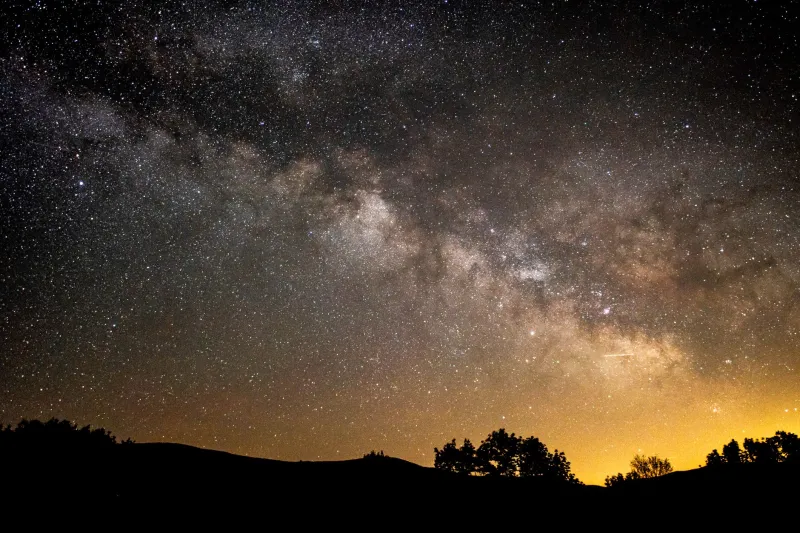
This is mythology operating at full register, and mythology, by its nature, does not traffic in precision. The stars of Tolkien's sky are said to have been kindled by Varda, the Lady of the Stars, from the dews of the Two Trees and the ancient light gathered before the Trees were destroyed. They serve narrative and spiritual purposes — they are beacons of hope, markers of divine intention, the light that Galadriel herself captures in her famed phial. What they are not, in any rigorous sense, is explained.
Are they physical bodies orbiting Arda in a conventional astronomical sense? Are they manifestations of Ainuric will, sustained by ongoing divine effort? The texts gesture toward answers without committing to them, and the tension between a mythological framework and the implicit cosmological questions it raises has kept scholars and enthusiasts occupied for decades.
The Flat World Problem
Perhaps no single cosmological question has generated more fan discussion than the transformation of Arda from a flat world to a round one at the conclusion of the Second Age. When Númenor is drowned and the Undying Lands are removed from the circles of the world, Tolkien describes a fundamental restructuring of reality itself. The world is made round. The straight road to Valinor becomes inaccessible to mortal sailors — though the Elves, for a time, may still find it.
The implications of this are staggering, and Tolkien himself acknowledged the difficulty. How does a world become round? What does that mean for the physical laws governing Arda before the change? Was the flat earth a literal description of geography, or a mythological mode of perception that the text employs without committing to as objective fact? Christopher Tolkien's editorial notes in The History of Middle-earth series surface his father's own uncertainty on these points, and that uncertainty has proven enormously generative for fan theorists.
Communities across the internet — from dedicated Tolkien forums to the comment threads of long-running fan wikis — have produced elaborate reconstructions of pre-Akallabêth Arda, complete with attempts to reconcile the flat-world geography with the astronomical observations implied elsewhere in the texts. Some theorists argue for a kind of divine perceptual overlay: that Arda was always physically spherical but experienced as flat by its inhabitants until the Valar altered the conditions of mortal perception. Others insist on a more literal reading, accepting the cosmological rupture as a genuine metaphysical event without a naturalistic explanation.
Varda's Stars and the Light Before the Sun
The question of the stars connects to another rich vein of cosmological mystery: the nature of light in Arda before the creation of the Sun and Moon. Tolkien describes a primordial world lit first by two great Lamps, then by the Two Trees of Valinor, and only later by the vessel of Arien carrying the last fruit of Laurelin across the sky. The stars, kindled by Varda, predate the Sun — which means the world knew starlight before it knew daylight in the conventional sense.
Fan theorists have spent considerable energy interrogating what this implies. If the stars are Arda-specific creations rather than distant physical suns, does that mean the observable universe of Tolkien's world differs fundamentally from our own? Some readers, drawing on Tolkien's letters and his remarks about the relationship between his mythology and Christian cosmology, argue that the stars of Arda are best understood as spiritually distinct from the astronomical bodies we observe — that Tolkien's cosmos is nested within our own without being reducible to it.
This line of inquiry touches something deeply characteristic of how serious Tolkien fandom operates. The professor himself was a Catholic, and his mythology is saturated with theological resonance. Reading his cosmological silences as spiritually intentional — as mysteries that resist resolution because mystery is their point — feels truer to the spirit of the work than any attempt to produce a unified field theory of Arda's physics.
The Ethics of Completion
Yet the impulse to complete the incomplete is not easily dismissed, and the Tolkien fan community has never pretended otherwise. The decades of work represented by sites dedicated to reconstructing the languages, the genealogies, the historical timelines, and yes, the cosmological frameworks of Middle-earth represents a form of devotion that deserves to be taken seriously on its own terms.
There is a genuine tension here that the most thoughtful members of the community acknowledge openly. Tolkien was not merely careless when he left these gaps. He was, in many cases, deliberately preserving the quality of mythological depth that makes his world feel ancient and real rather than engineered. A myth that explains everything is not a myth — it is a manual. The Ainulindalë works precisely because it does not resolve into a physics textbook.
And yet the fan theorist who spends months constructing a coherent model of Arda's astronomical structure is not betraying that spirit. They are enacting it. They are doing, in their own register, what Tolkien himself did when he looked at the gaps in Norse and Finnish mythology and felt the urge to fill them with something true. That urge is not a failure of reverence. It may be its highest expression.
What the Void Teaches Us
The Void — the Timeless Halls beyond the world, the darkness outside Eä — is perhaps the ultimate cosmological mystery in Tolkien's work. It is where Melkor was cast after the War of Wrath. It is, in some sense, the boundary condition of the entire created order. Tolkien wrote about it in ways that are suggestive rather than definitive, and the community of fans who have wrestled with its implications have produced some of the most philosophically ambitious secondary writing in the entire tradition of Tolkien scholarship.
What draws readers to these questions, again and again, is not merely the puzzle-solving satisfaction of filling in blanks. It is the experience of standing at the edge of a world that feels genuinely vast — vast enough to contain mysteries that its own creator could not fully articulate. That is a rare quality in any fictional world, and it is, in no small part, what has kept the lights burning in the Galadhrim community and in Tolkien fandom more broadly for so many years.
The stars Varda kindled burn on, and we are still looking up at them, still asking what they are made of, still unwilling to look away.